If you have asked three installers for quotes, you have probably seen three different prices for the same house — sometimes differing by a third. That is not a mystery: solar pricing has real structure behind it, and once you understand the five cost blocks (panels, inverter, batteries, mounting and labor, permits and paperwork), you can read any quote like an engineer and spot the padding. The sections below give you the actual 2026 numbers for each block, the total cost of the three most common system sizes, and the checklist that protects you from the five most common ways quotes get inflated.
The five cost blocks of a solar system
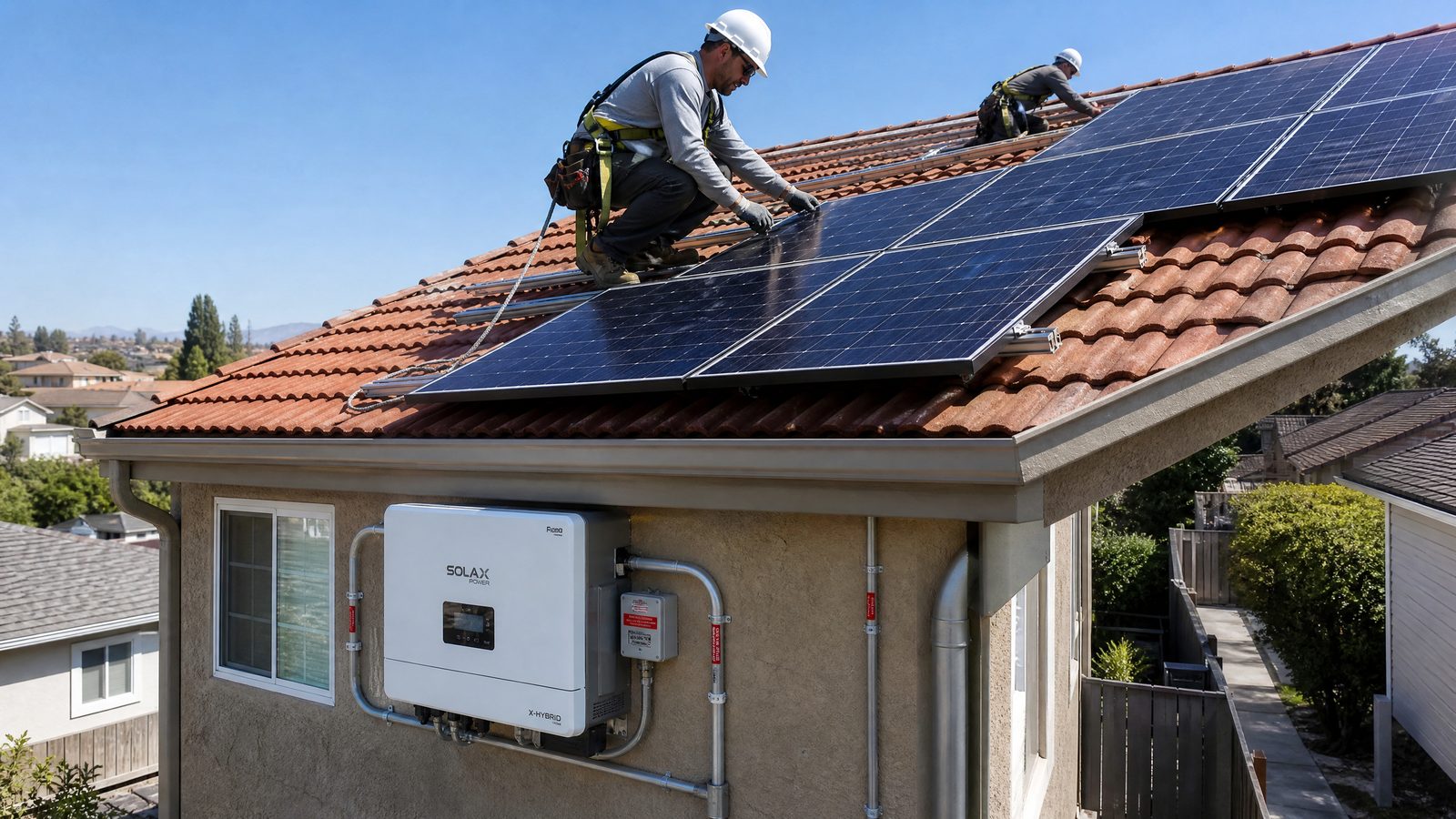
Every solar quote, anywhere in the world, is the same five blocks stacked together. The panels themselves — 2026's cheapest component, trading below $0.20 per watt at wholesale for tier-1 modules, roughly $0.25-0.35/W at retail. The inverter — a string inverter adds $300-800 for a home system; a hybrid inverter (needed if you want batteries later) adds $600-1,500. The battery, if any — $3,000-8,000 for home-scale lithium, the single largest optional block. The mounting, cabling and labor — roof rails, ballast, DC cable (thicker and longer runs cost more), earthing, and installer days; in most markets this block now equals or exceeds the panel cost. And permits and paperwork — net-metering applications, inspections, and utility connection fees, which vary enormously by country.
| System size | Grid-tied (no battery) | With 5-10 kWh battery | Typical use |
|---|---|---|---|
| 3 kW | $2,500 – $3,500 | $5,500 – $9,500 | Small home, water heating offset |
| 5 kW | $4,000 – $5,500 | $7,000 – $12,000 | Average family home |
| 10 kW | $7,500 – $11,000 | $11,000 – $18,000 | Large home, AC-heavy, small business |
These ranges cover most markets in 2026 — South Asia, the Middle East and East Africa sit toward the lower end thanks to lower labor costs and heavy subsidies in some countries, while North America and Western Europe sit higher because of permits, inspection fees and union-rate labor. The structure of the price is the same everywhere; only the labor block moves.
Where the money actually goes
Take a $5,000, 5 kW grid-tied quote and split it: about $1,000-1,200 is panels, $500-800 the inverter, $900-1,300 mounting rails and clamps, $400-700 DC/AC cable and protection devices, $1,400-2,000 labor and logistics, and the remainder permits, earthing and margin. The striking fact for 2026 buyers: the panels are no longer the expensive part. A decade ago they were two-thirds of the bill; today they are a quarter. That is why the biggest savings come not from negotiating panel prices but from simplifying the install — a clear, single-plane roof with short cable runs can be 15% cheaper to install than a complex multi-faceted roof with the same panel count.
Budget rule: system price ≈ $800–$1,200 × size (kW), grid-tied — add $3,000–$8,000 for a battery
Batteries: the decision that changes everything
A lithium home battery costs $3,000-8,000 installed depending on capacity, and it is the line item that separates a $5,000 project from a $12,000 one. Whether it is worth adding depends on your local economics: where net metering credits exports at full retail rate, the battery's payback stretches to 10+ years and most buyers are better off adding it later, when prices fall further; where exports pay avoided-cost rates or the grid cuts out every evening, the same battery pays back in 3-5 years and becomes the heart of the system. Note also that batteries have a shorter life than panels (10-15 years vs 25-30), so a system with a battery will see a mid-life replacement cost that a battery-less system never does.
The five quote checks
Before signing, verify these five line items. First, panel tier and degradation warranty — tier-1 modules with a 25-30 year performance warranty cost barely more than budget panels in 2026 and are almost always worth the small premium. Second, workmanship warranty — the panels are warranted by the factory, but who warrants the roof penetration, the wiring, and the earthing? You want 5+ years of installer-backed workmanship cover. Third, cable gauge and length — undersized DC cable is the cheapest way an installer pads margin and the most common cause of future production loss. Fourth, earthing and lightning protection — non-negotiable in storm-prone regions, frequently skipped in cheap quotes. Fifth, permitting responsibility — confirm the quote includes net-metering paperwork and inspections; a "panels only" price that shifts permitting to you is not cheaper, it is just moved.
Field note (Ma'an, southern Jordan): the quotes we reviewed in the south varied up to 40% for identical 5 kW systems, and the difference was almost never the panels — it was the mounting structure, the cable run across the roof, and whether earthing was included at all. Our rule after a hundred site visits: never accept a quote without a per-component breakdown, and always ask the installer to show you the DC cable gauge they plan to use. The cheapest quote we ever accepted turned out to have undersized cable; the most expensive turned out to include a full earthing loop the others had skipped.
Payback at 2026 prices
At current prices and typical electricity rates, a correctly sized grid-tied system pays back in about 4-7 years in markets with good retail rates and full net metering, and 6-9 years elsewhere. Add a battery and the payback lengthens by 2-4 years unless your grid is unreliable or exports are poorly compensated. After payback, the system delivers essentially free electricity for two decades or more — with one likely mid-life cost: string inverters typically need replacement around year 10-12, at $500-1,500 depending on system size. Plan for it, and the 25-year economics stay excellent.
Frequently asked questions
How much does a complete solar system cost in 2026?
In most markets, a complete grid-tied system costs roughly $800 to $1,200 per kW installed. A 3 kW home system runs about $2,500 to $3,500, a 5 kW system about $4,000 to $5,500, and a 10 kW system about $7,500 to $11,000 — before any local subsidy or net-metering incentive. Off-grid systems cost 30-50% more because of batteries. Prices vary by country: South Asia and parts of the Middle East sit at the lower end, while North America and Europe sit higher because of labor and permit costs.
What is the cheapest part and the most expensive part of a solar system?
The panels themselves are now the cheap part — often under 20 cents per watt at wholesale. The expensive parts are the battery (if you add one: $3,000 to $8,000 for home-scale lithium), the hybrid inverter, and installation labor plus mounting and cabling. A battery-less grid-tied system is always the budget entry point.
Are cheap solar panels worth buying?
For most buyers, tier-1 panels from established manufacturers are the right choice: the price gap between budget and tier-1 has collapsed to roughly 10-15%, while the difference in degradation warranty (25-30 years vs 10-12 years) is large. Budget panels often make sense only for small off-grid projects where the system life target is short.
Does adding a battery double the system cost?
Not quite, but close. A 5 kWh home battery adds roughly $3,000 to $5,000 installed, and a 10 kWh unit $5,000 to $8,000. Whether you need one depends on your grid reliability and your export compensation: where net metering pays full retail, batteries pay back slowly; where exports pay pennies or the grid cuts out daily, the battery earns its price quickly.
What hidden costs should I check in a solar quote?
Five line items catch most overcharging: (1) mounting structure and ballast for your roof type, (2) DC cable length and gauge — long runs need thicker cable, (3) earthing/grounding and lightning protection, (4) permit, inspection and net-metering paperwork fees, and (5) the warranty on workmanship, not just on the panels. A quote that lumps everything into one number without these breakdowns should raise a red flag.
How fast does a solar system pay for itself?
At 2026 prices, a well-sized grid-tied system typically pays back in 4 to 7 years in markets with good electricity rates and full-retail net metering, and in 6 to 9 years elsewhere. After payback, the system produces essentially free electricity for 20+ years, with only inverter replacement (around year 10-12) as a likely future cost.